
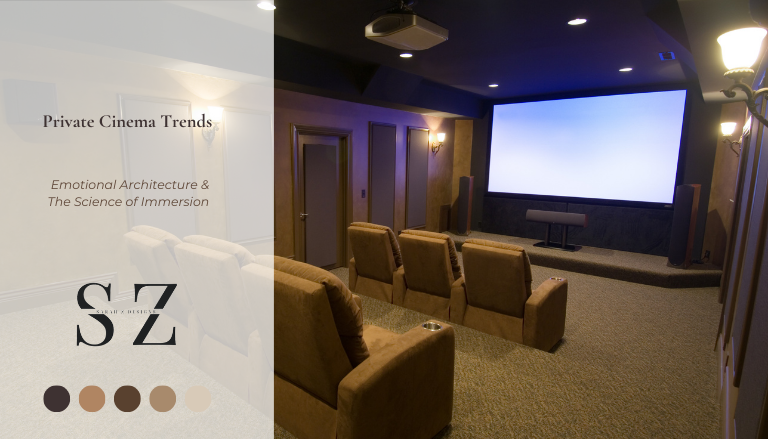
Private Cinema Trends: Emotional Architecture & The Science of Immersion
In the pantheon of ultra-luxury residential design, the private cinema occupies a unique and formidable position. While the kitchen may command the highest financial investment due to its cabinetry and appliances, the private cinema represents the pinnacle of engineering complexity and sensory calibration. It is a space where the rigorous laws of physics collide with the ethereal nature of storytelling.
At Sarah Z Designs, we look beyond the archaic concept of a ‘media room’—a mere container for a television—and instead focus on ‘Emotional Architecture.’ This is the discipline of crafting an environment that does not merely display a film but physically and psychologically transports the viewer into it. In the high-stakes real estate market of Miami, where discernment is the currency of value, a dedicated cinema must offer more than visual fidelity; it must offer a total suspension of disbelief, achieved through a mastery of acoustics, lighting psychology, and invisible technology.
The transition from a living space to a cinematic sanctuary requires a shift in perspective. We are no longer designing solely for aesthetics; we are designing for the control of light and sound energy. The modern private cinema is a machine for immersion, disguised as a luxurious lounge. It is the second most technically demanding space in a residence, requiring a seamless integration of structural engineering, electrical planning, and interior design. To understand the future of private entertainment, one must look at the convergence of three critical pillars: acoustic sculpting, the psychology of illumination, and sensory ergonomics.
Acoustic Sculpting: The Invisible Geometry
Sound is physical. It is energy moving through air, interacting with every surface it touches. In a poorly designed room, these sound waves collide, create echoes, or accumulate in corners to form ‘muddy’ bass responses known as standing waves. Acoustic sculpting is the art of shaping the room’s geometry and surface materials to govern the trajectory of sound. It is not simply a matter of placing soft panels on a wall; it is about orchestrating the behavior of audio frequencies to ensure that a whisper is as clear as an explosion.
We utilize a combination of absorption and diffusion. Absorption, achieved through dense, porous materials, prevents sound from bouncing chaotically. Diffusion, often achieved through angular wood slats or geometric panels, scatters sound waves to make the room feel larger and more enveloping than its physical dimensions would suggest. This is where design meets function: these acoustic treatments are often concealed behind stretched fabrics or integrated into bespoke millwork, becoming indistinguishable from the room’s architectural identity. For examples of how we integrate functional millwork into luxury spaces, you can explore our bespoke portfolio projects, where technical necessities are rendered invisible by design.
Furthermore, isolation is paramount. A true private cinema is a ‘room within a room,’ decoupled from the home’s main structure to prevent noise leakage. This isolation allows for the full dynamic range of a soundtrack to be experienced without disturbing the tranquility of the rest of the residence. It is the silence between the notes that defines true luxury audio.
The Engineering of Psychoacoustics
The evolution of private cinemas in 2026 places a heavy emphasis on psychoacoustics—the study of how humans perceive sound. In our Miami projects, we don’t just treat walls for noise; we treat them for emotional impact. By manipulating how sound reaches the ear, we can make the viewer feel like they are in a vast cathedral or a tight cockpit, perfectly matching the visual narrative on screen. This spatial audio mapping is what creates the “haunting” realism that defines high-performance luxury.
To achieve this, we utilize computational fluid dynamics (CFD) for sound air-flow. This allows us to predict how low-frequency energy (bass) will pool in a room before a single nail is driven. By neutralizing these pressure zones through ‘bass traps’ hidden within the architecture, we ensure that every seat in the theater experiences the same chest-thumping impact without the distortion of vibration or rattle.
The Psychology of Lighting: Preparing the Brain for Immersion
Lighting in a cinema environment serves a dual purpose: aesthetic enhancement and psychological preparation. The transition from the bright, chaotic world outside into the focused, dark cocoon of the theater is a ritual. We design lighting scenes that guide the brain into a state of receptivity. This involves more than just a dimmer switch; it requires a choreographed sequence of illumination.
Before the film begins, the lighting should highlight the architectural details of the room—the texture of the wall coverings, the gleam of the sconces, the richness of the carpet. This establishes the room as a social space. As the ‘show’ command is initiated, the lights do not merely turn off; they fade in a specific order. The rear lights dim first, pushing the focus forward. The sconces lower to a warm glow, and finally, the overheads extinguish, leaving only the screen or a subtle bias light behind it. This sequence signals to the nervous system that it is time to focus.
We also incorporate circadian-friendly lighting for post-viewing. When the film ends, jarring bright lights can break the emotional spell. Instead, we program a ‘recovery’ scene—a soft, warm wash of light that allows viewers to reacclimate gently, preserving the emotional resonance of the film as they discuss it. This attention to the ‘liminal space’ between reality and fiction is what separates a high-end installation from a standard setup.
Biometric Sync and Visual Comfort
In the next era of luxury, lighting will be biometrically synced. Imagine a theater that detects the time of day and adjusts its “fade-to-black” speed to match your body’s natural cortisol levels. Late-night viewings utilize more amber-heavy spectrums to protect your sleep cycle, ensuring that even after an action-packed blockbuster, your brain can transition into a restorative state once the credits roll.
Furthermore, the integration of Black-Hole Technology in paint and fabric finishes ensures zero light reflection. Standard dark paints often have a slight sheen that catches the projector’s light, pulling the eye away from the screen. By using ultra-matte, light-absorbing materials, the room “disappears” entirely once the movie starts, leaving the screen as the only light source in the universe of the room.
Sensory Ergonomics: The Tactile Experience
Immersion is easily broken by physical discomfort. Sensory ergonomics extends beyond the simple inclusion of a recliner; it involves the study of sightlines, temperature regulation, and tactile feedback. The Society of Motion Picture and Television Engineers (SMPTE) provides rigorous standards for viewing angles, ensuring that every seat in the house has a distortion-free view of the screen without neck strain. We calculate these angles precisely before a single piece of furniture is ordered.
The materials chosen for the seating are equally critical. While leather is traditional, it can be reflective (impacting acoustics) and temperature-variable. We often opt for high-performance velvets or breathable Alcantara, which offer superior acoustic absorption and thermal comfort. The goal is for the chair to essentially disappear from the user’s consciousness, leaving them suspended in the narrative.
Temperature control must also be silent; standard HVAC systems introduce a noise floor that destroys high-fidelity audio. We implement low-velocity, high-volume air displacement systems that cool the room without the rush of wind noise.
Somatic Immersion and Haptic Integration
Beyond visual and auditory inputs, the body perceives story through somatic feedback. We are now integrating haptic transducers directly into the theater’s flooring and seating frames. Unlike simple “butt-kickers,” these are precision-engineered devices that translate low-frequency sound into subtle vibrations. When a jet flies overhead on screen, you don’t just hear the roar; you feel the slight tremble in your chest, grounding the digital experience in physical reality.
This tactile layer also extends to the thermal architecture of the space. In our Miami Beach estates, we manage the micro-climate of the cinema to remain at a consistent 68-70°F with specific humidity controls. This prevents the “stuffy” feeling often associated with soundproofed rooms, ensuring that the air feels as crisp and fresh at the end of a three-hour epic as it did at the beginning.
Invisible Tech: The Phantom Room
In the world of ultra-luxury, technology should serve the user, not dominate the visual landscape. The trend is toward ‘Invisible Tech’—systems that provide reference-quality performance while remaining completely hidden when not in use. This prevents the cinema from looking like a server room or an electronics store.
We utilize projection screens that retract into the ceiling or remain hidden behind motorized artwork. Speakers are plastered into the walls or hidden behind acoustically transparent fabrics that match the room’s decor. The projector itself—often a massive, heat-generating device—is housed in a ventilated ‘hush box’ or a separate projection booth, removing both the noise and the visual bulk from the primary space. The result is a room that feels like an elegant lounge or a library, which transforms at the touch of a button. To see how we balance aesthetic elegance with functional requirements in other areas of the home, view our curated design gallery.
The Convergence of 8K and MicroLED
While projectors remain the “purist” choice, 2026 is seeing a shift toward MicroLED walls. These emissive displays offer perfect blacks and HDR peaks that projectors cannot match in residential settings. When turned off, these screens can be programmed to display high-resolution digital art or mimic a window view, further pushing the “phantom room” concept where the tech only exists when called upon.
The processing power required for these systems is relegated to a remote AV Rack Room, often cooled by dedicated liquid-cooling loops to ensure silent operation. This removal of hardware from the theater space allows us to focus on the ‘Soft Architecture’—the fabrics, woods, and textures that make the room feel like a sanctuary rather than a laboratory.
Comparative Analysis: Media Room vs. Private Cinema
Feature | Standard Media Room | Immersive Private Cinema |
Acoustics | Basic insulation; reflective surfaces often ignored. | Calculated geometric diffusion, absorption, and sound isolation (room-within-a-room). |
Visual Focus | Large TV competing with ambient light. | Native 4K/8K Projection on acoustically transparent screens; controlled light environment. |
Lighting | Standard dimmers; often causes screen glare. | Psychological zoning; automated scenes synchronized with content start/stop. |
Audio | Soundbar or visible speakers. | Dolby Atmos (object-based audio); speakers hidden behind millwork or fabric. |
Purpose | Multi-use casual viewing. | Dedicated narrative transport and emotional immersion. |
The Miami Context: A Market of Discernment
In the Miami luxury real estate market, a private cinema is no longer a novelty; it is an expectation. However, the differentiation lies in the execution. Developers and homeowners are moving away from the dark, cavernous ‘dungeons’ of the early 2000s toward spaces that are inviting, architecturally significant, and technically flawless. A well-executed cinema adds significant value to a property, not just in monetary terms, but in the lifestyle caliber it signals.
It demonstrates a commitment to quality that permeates every layer of the residence. The convergence of design and technology allows us to create spaces that are uniquely personal. Whether it is a cinema that doubles as a digital art gallery or a listening room for high-fidelity vinyl playback, the private cinema is the ultimate expression of how we choose to experience culture in our homes.
The Rise of the “Cinema Lounge”
The latest demand in Miami is the Hybrid Cinema Lounge. This design allows for a seamless transition between a formal cocktail lounge and a reference-grade theater. By using motorized acoustic drapery and high-gain screens that can fight ambient light, we provide our clients with the flexibility to host a Super Bowl party in a bright, social setting, or an intimate movie night in total darkness.
This flexibility is essential for the modern executive who uses their home for both high-level networking and deep personal recovery. The cinema is the “Variable Asset” of the home, capable of shifting its identity to meet the emotional needs of the host at any given moment.
Future-Proofing the Narrative
As we look toward the future of entertainment, including Spatial Computing and VR/AR integration, the private cinema must remain adaptable. We pre-wire our theaters with high-bandwidth fiber optics to ensure that when the next leap in immersive technology occurs, the architecture is ready to support it. Investing in a cinema today is not just about the screen you buy; it is about the infrastructure you build.
The final layer of luxury is Ease of Use. A Sarah Z cinema is controlled via a single, intuitive interface—often integrated into the room’s furniture or a subtle wall-mounted panel. There are no complicated remote sequences; the technology is at your command, but it never demands your attention.
Frequently Asked Questions
- What is the fundamental difference between a home theater and a private cinema?
While the terms are often used interchangeably, a ‘home theater’ usually refers to a system added to an existing room. A ‘private cinema’ is a purpose-built environment where the architecture, acoustics, and technology are designed in unison from the ground up to replicate or exceed commercial theater standards.
- How does the shape of the room affect the sound quality?
Room dimensions are critical. A perfectly square room is the worst possible shape for acoustics because it amplifies specific frequencies (standing waves), causing uneven bass. Rectangular rooms with calculated ratios (Golden Trapagon) allow for the most even distribution of sound energy.
- How does Sarah Z Designs approach the initial planning of a private cinema?
We begin with a ‘usage profile’ and a structural analysis. Before discussing colors or fabrics, we determine the optimal screen size relative to the room depth and analyze the acoustic properties of the raw space. We then collaborate with audio-visual engineers to integrate the technical hardware into our design vision, ensuring the technology supports the aesthetic rather than compromising it.
- Can a private cinema be installed in an open-concept floor plan?
True immersion requires light and sound control, which is difficult in open concepts. However, using motorized blackout shades, acoustic drapery, and directional speakers, we can create a high-performance ‘media lounge’ experience, though a dedicated enclosed room remains the gold standard for cinematic isolation.
- What is the role of automation in a modern private cinema?
Automation is the conductor of the experience. A single button press should dim the lights, close the shades, adjust the thermostat, turn on the projector, and set the volume. This seamless integration removes the friction of using multiple remotes, allowing the user to focus entirely on the content.
The investment in a private cinema is an investment in time—quality time spent with family, friends, and the art of storytelling. It transforms the passive act of watching into an active, sensory event. By merging the precision of acoustic engineering with the warmth of luxury interior design, we create spaces that resonate on an emotional level long after the credits roll.
To explore how we can transform your residence with a bespoke cinema experience that blends emotional architecture with technical perfection, we invite you to begin the conversation. Please visit our contact page to schedule a consultation.


